Concrete retaining walls in Upland CA - a wall that holds your slope and drains
Is your slope washing onto the patio, or is an old wall starting to lean? We build concrete walls that hold the ground, with drainage built in.
- Licensed and fully insured.
- Free quotes on site.
- Expect a reply within 1 business day.
What goes into building a concrete retaining wall in Upland?
A concrete retaining wall in Upland is a wall we form, pour and finish on site to hold back a slope, so you get flat ground you can use and the hill stays where it is.
Most calls start with a bank that drops mud on the patio every winter, or a yard too steep to use for anything. The price mostly comes down to how long and how tall the wall is, what the ground under it is like, how much drainage it needs and how easy it is to get a crew and concrete to the spot. Poured or block matters too. The schedule turns on the design, whether your wall needs a city permit, which we sort out with you at the estimate, and the curing, the wait while fresh concrete gains strength before we backfill against it. Your written estimate lays out the steps and what's included, so you're not guessing at any of it.
How do you know your yard needs a retaining wall?
Dirt washing onto your patio
After a hard rain you find mud on the patio or along the side of the house, and the slope above looks a little lower every year. That usually means nothing is holding the bank, and every storm takes more of it, which makes the eventual wall taller and the cleanup bigger.
An old wall leaning out
A wall that tips forward, cracks across its face or pushes out at the bottom is usually being shoved by wet soil with nowhere for the water to go. Patching the face won't relieve that pressure, and the longer it leans, the more likely you're replacing the wall and whatever sits below it.
A yard too steep to use
If half your lot is a slope you can't mow, plant or set a table on, a wall can turn it into level ground. Planning the wall before you add a patio or pool saves tearing out new work later to make room for it.
How we build concrete retaining walls
I start by walking the slope to see where the water comes from and where it wants to go, because we plan the drainage behind the wall as part of the wall itself, not as an extra added at the end. We dig out for the footing, the wide base the wall stands on, down to firm ground and pack what goes under it. Then we set the forms and the rebar, steel bars that tie the wall to its footing and help it carry the weight of the soil. After the pour, the wall cures before we lay drain rock and a pipe with holes in it that carries water away, then backfill in layers and clean up. If the budget gets tight, I'll steer you toward a plainer face before a thinner footing or less drainage, because nobody sees the base once the dirt goes back, and it's what decides whether the wall stays straight.
A wall usually makes room for something else. The new flat ground above or below it is often where people put concrete pool decks, so we set the wall's height and drainage with the deck in mind. When a wall cuts into a hill to fit a workshop, storage room or garage, concrete floor installation usually comes next, and pouring both with the same crew keeps the levels lined up.
Poured concrete wall
Formed and poured in place to the shape of your slope, it suits a narrow side yard or a wall that has to sit close to the property line. On a tight lot, we'll talk through what fits before anything gets drawn up.
Block wall
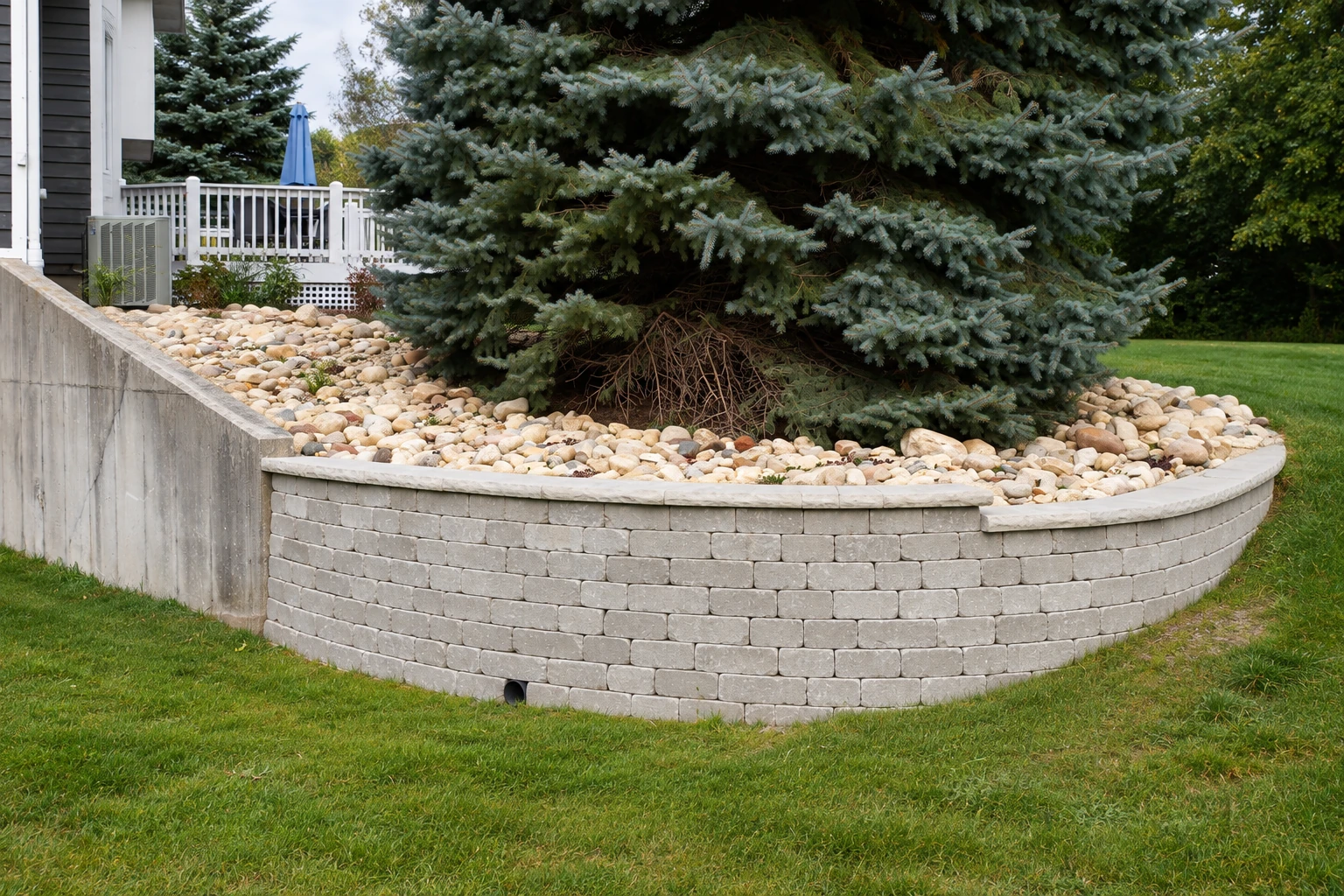
Stacked units with reinforcement laid in the soil behind them suit a spot where there's room to work behind the wall and you like the look of block. We'll lay out what each choice needs on your lot so you can compare them side by side.
Get a free on-site quote for your retaining wall
Send the form and expect a reply within one business day to set a time. I'll come out myself, look at the slope and answer your questions, and there's no pressure to book.
(909) 694-4021- Based in
- Upland, CA 91786
- Hours
- Mon–Fri: 6 AM–10 PM, Sat–Sun: 7 AM–11 PM
What happens when you call about a retaining wall in Upland?
Here's how a retaining wall job runs from your first call to the final walk, so you know what comes next at every step.
Call or send the form
Call (909) 694-4021 or fill out the form, and we'll set a time for me to come out to your property. A rough idea of how long and tall the wall needs to be helps me bring the right questions.
Walk the slope with me
I look at the job, the ground and where the water runs, hear what you have in mind and answer your questions right there. Point out the property line and anything you plan to build nearby, because both shape the wall.
Get a written estimate
You get a written estimate that lays out each step and what's included, so you can see where the money goes before you decide. If the wall needs a permit, we take care of that with the city.
Build it, then walk it
We pick a date that works for you and keep you posted as the work moves along, inside Upland's construction hours of 7 a.m. to 6 p.m. on weekdays. When it's done, we walk the finished wall with you.
Why Upland homeowners call D&K Upland Concrete for retaining walls
The owner on site, start to finish
I come out to look at the job myself, and I'm on site with our crew of finishers when we build it. The person who heard what you wanted is the one standing there when the forms go up.
Licensed and fully insured, and glad to show it
We're licensed and fully insured, and the state license board has a concrete contractor class for people who form, pour and finish concrete, so it's fair to ask any contractor what they hold. Upland also requires state-licensed contractors working in the city to carry a current city business license.
A written plan you can follow
I spent years scheduling crews for a busy construction company and learned the trade from the finishers I sent out, then started this business in Upland in 2023. We plan each job out step by step, and the work is backed by our satisfaction guarantee.
On a retaining wall, the part that matters most ends up buried, so I'd rather explain the plan twice than leave you guessing. Tell us about your slope and I'll come out and look.
Retaining walls, permits and sloped lots in Upland
The city's Building and Safety Division decides whether a wall needs a permit. Its list of work that doesn't need one names block walls 2 feet or less and doesn't mention concrete retaining walls, so don't assume yours is exempt. If your wall needs a permit, I'll tell you at the estimate and we'll handle the application with the city's building office.
State maps from the California Geological Survey show where liquefaction, ground losing strength in a strong quake, or quake-triggered landslides may happen, and building on a property in one of those zones may mean looking into the hazard and reducing it during permitting. We see plenty of yards that step down a grade on jobs in Rancho Cucamonga and Claremont, and we check the ground and the water the same way there before we price a wall.
Questions about retaining walls in Upland
How much does a poured concrete retaining wall cost in Upland?
Across the US, hiring a contractor to build a poured concrete retaining wall usually costs about $30 to $50 per square foot. That's a national figure, not our price, and it can swing a lot with the project, the site's location, the design and the scope. Your written estimate sets out the steps and what's included for your wall.
Is poured concrete or block better near a property line?
Poured concrete is usually the better fit on a tight lot. A block wall needs geogrid, a reinforcing mesh laid in the soil behind it, and that mesh sometimes can't extend into a neighbor's property. When the wall has to sit close to the line, that often settles it.
Why does drainage matter behind a retaining wall?
Drainage matters because neither poured concrete nor block walls are designed to hold back water, so full drainage behind the wall is essential either way. Over the years, drains can stop working from earthquake movement, heavy rain, clogged filter material, poor backfill or building flaws. Water that collects behind a wall can bring it down once it reaches a critical level.
What is the best way to choose between a cantilever and a gravity retaining wall?
The best way is to weigh concrete against design work. A cantilever wall, a thinner wall standing on a wide footing, uses much less concrete than a solid gravity wall, but it needs more design and a careful build. Your space, the slope and the ground decide which one makes sense.
What kind of ground does a concrete retaining wall need?
Firm ground suits a cantilever wall best, according to Wisconsin's highway bridge manual, and weak or settling ground may need piles or ground improvement. Piles add significantly to the cost, so the soil on your lot shapes the budget early. We look at the ground before we price the wall.
How do I request a building permit in Upland?
You request it online, because Upland's Building and Safety Division takes building permit requests only online. If your wall needs one, we handle the application with the city for you, as covered above.
Work that often goes with a retaining wall
Concrete floor installation
Cutting into a hillside to make room for a workshop, storage room or garage leaves you with level ground that needs a solid, even floor poured on it.
Concrete pool decks
Once the slope is held back, the flat ground beside your pool can take a deck that drains away from the water and stays comfortable underfoot.
Where we build retaining walls around Upland
D&K Upland Concrete is based in Upland, California, and builds retaining walls in Ontario, Rancho Cucamonga and the other cities around it. The 12 cities below each have their own page, and they're not the only places we work.
Upland, CA
Get a plan for your retaining wall
Have photos of the slope, the wall's rough length and height, and how close it sits to the property line ready, and we can start sorting out poured or block on the first call.